Complete each problem below by hand. Show your work and provide a reason for each step. Calculators are not allowed on this assignment.
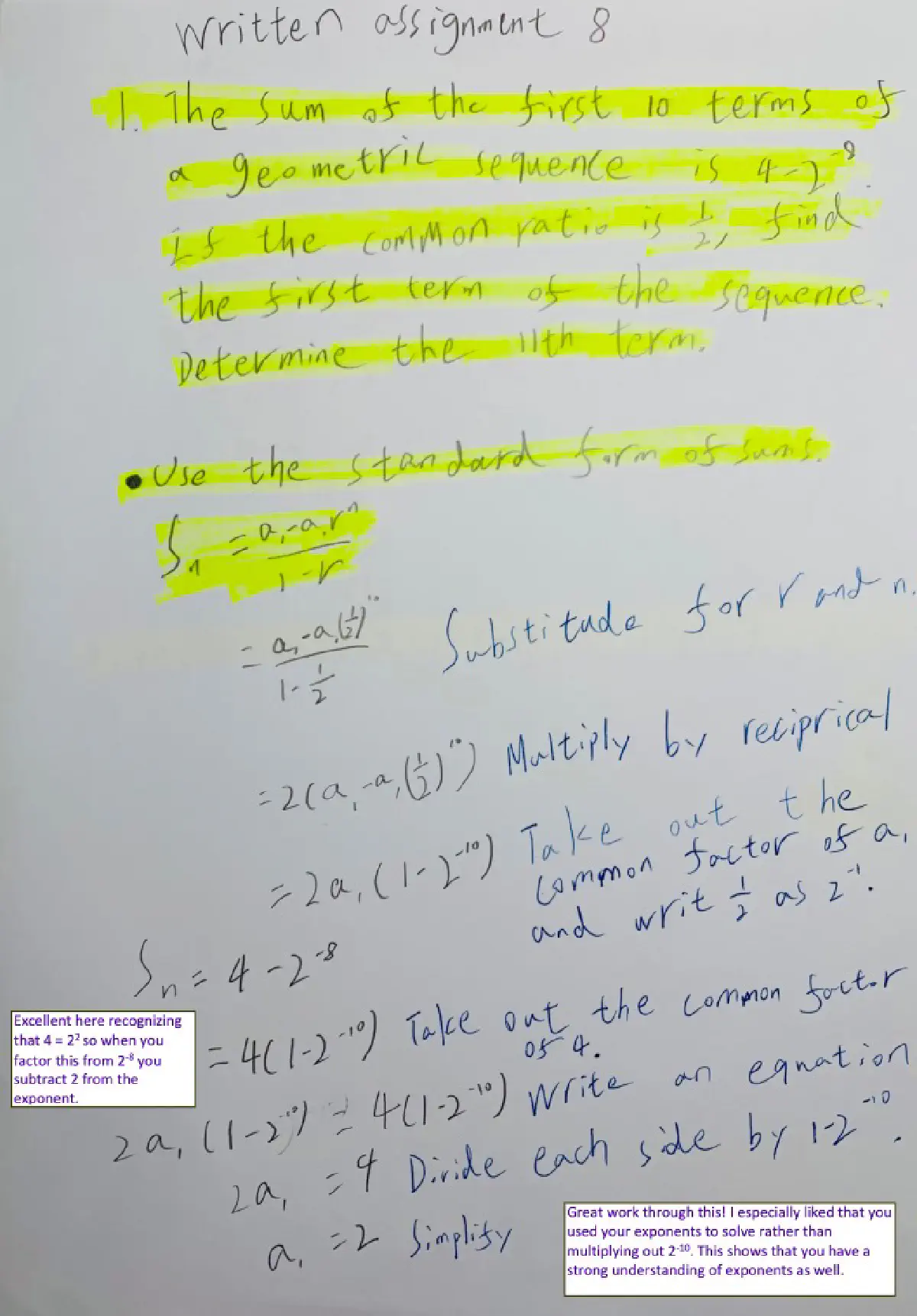
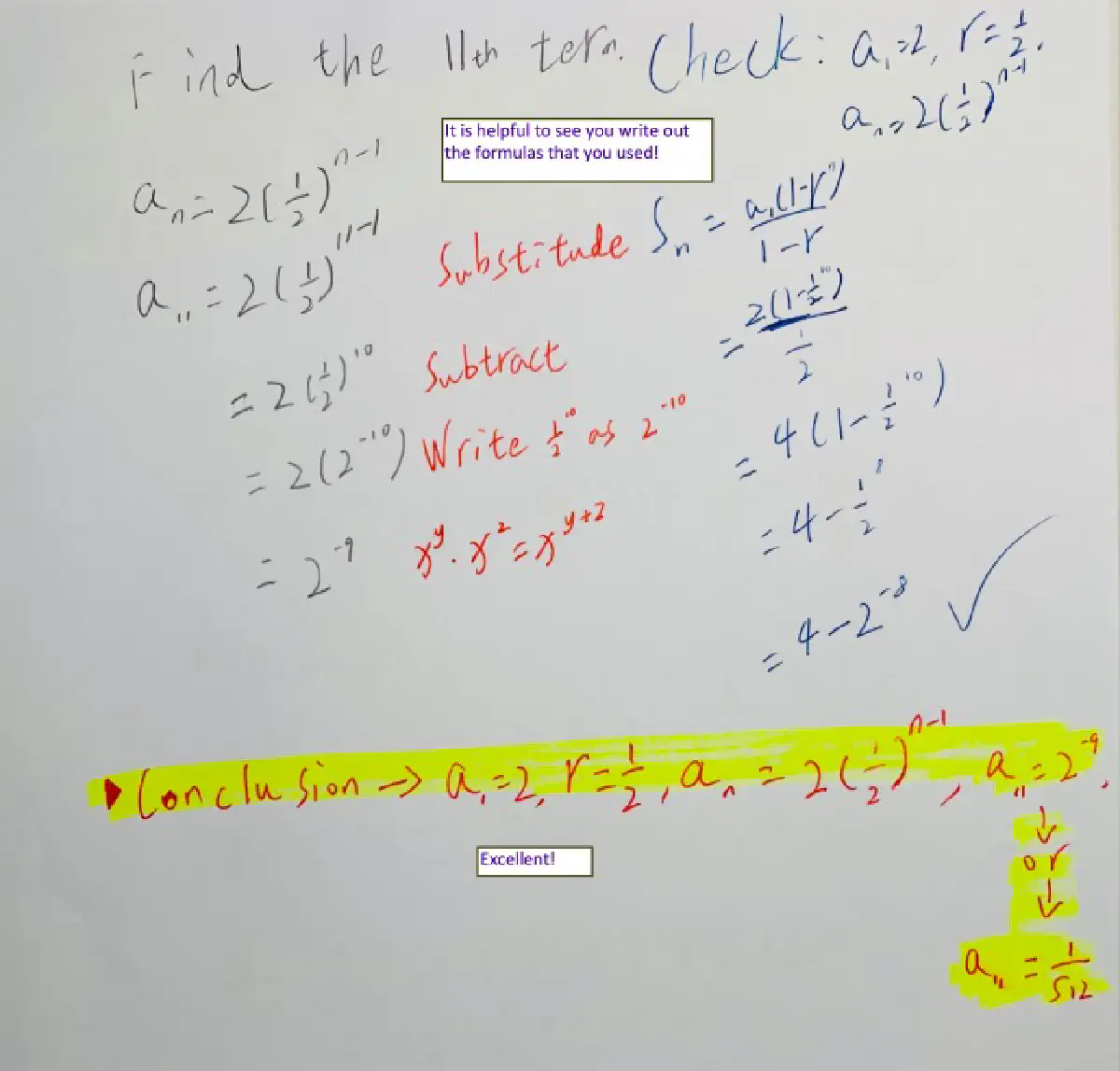
- The sum of the first 10 terms of a geometric sequence is $4−2^{−8}$. If the common ratio is $\frac{1}{2}$, find the first term of the sequence. Use this to determine the 11th term of the sequence.
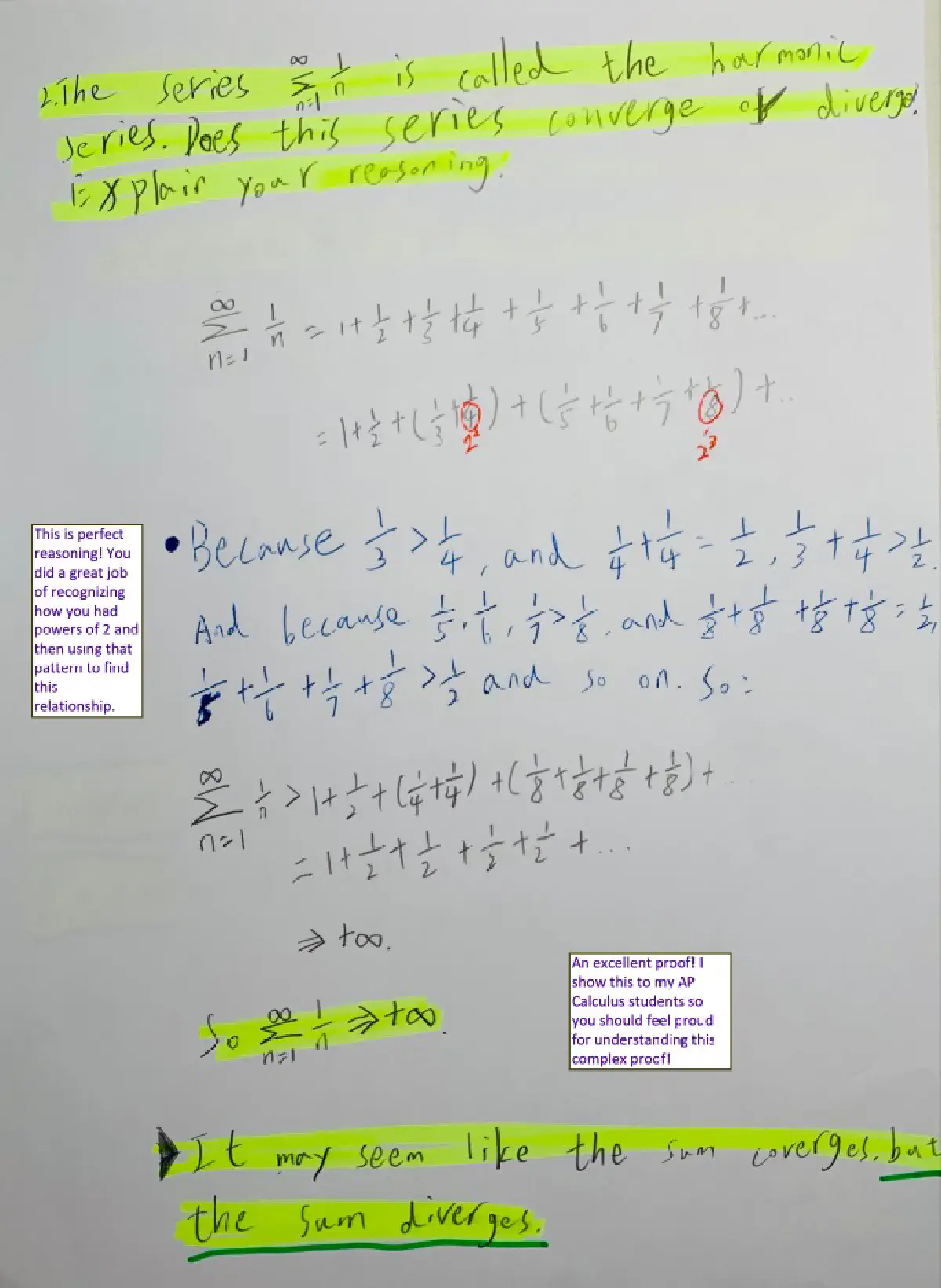
- It can be difficult to imagein that the sum of an infinite nmber of values is equal to a finite number. When $\sum\limits_{n=1}^{\infty}a_n=s$, where $s$ is a real number, we say the sum converges, when the sum does not converge we say it diverges. The series $\sum\limits_{n=1}^{\infty}\frac{1}{n}$ is called the harmonic series. Does this series converage or diverge? Explain your reasoing.
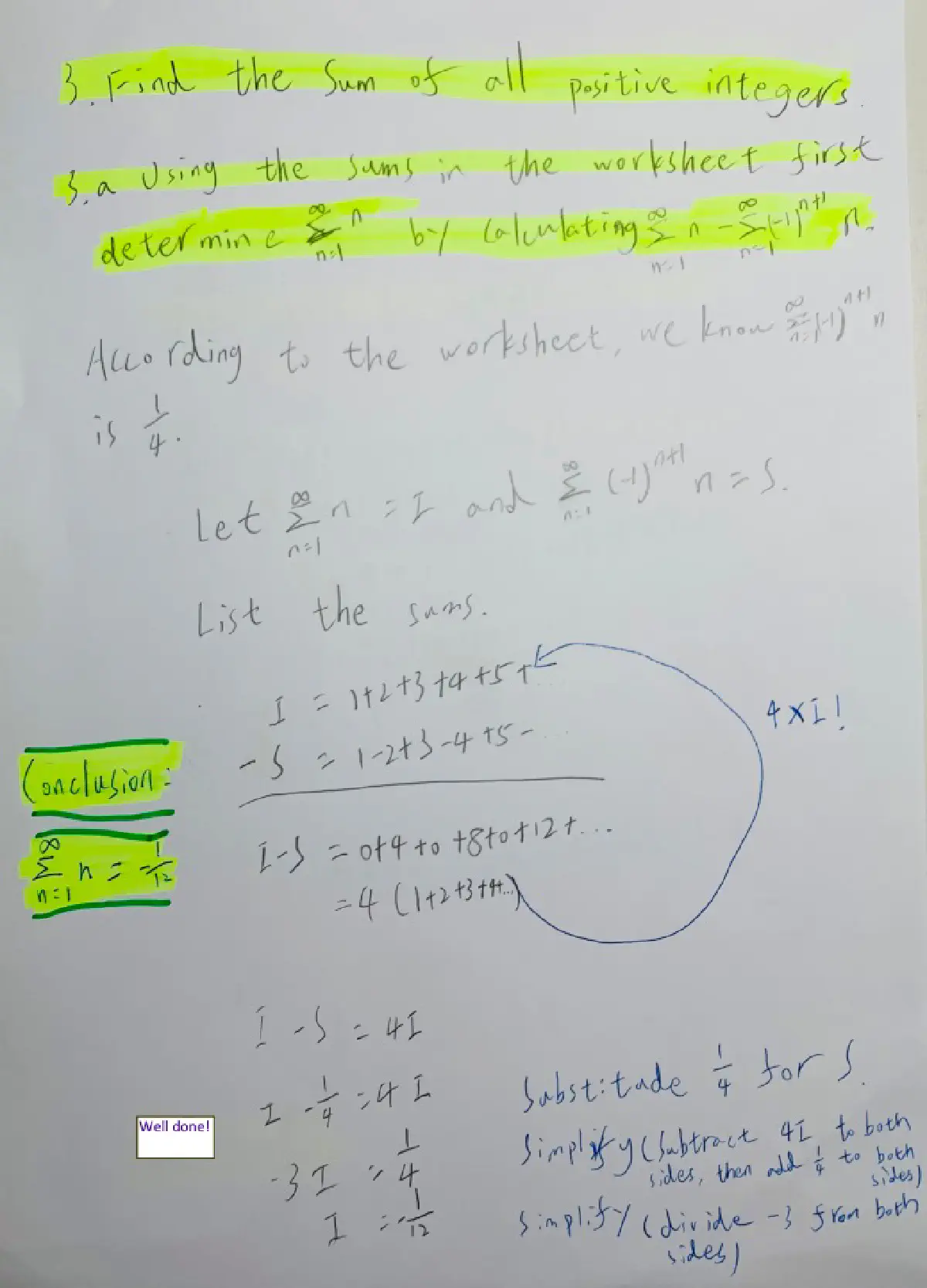
- We wish to find the sum of all positive intergers, that is $1+2+3+4+\dots$ Note we are not looking for a finite sum, but the infinite sum of all intergers.
HonorsTopic:Convergence
We will try to find a solution using two different methods.
a. Using the sums in the worksheet first determine $\sum\limits_{n=1}^{\infty}n$ by calulating $\sum\limits_{n=1}^{\infty}n−\sum\limits_{n=1}^{\infty}(−1)^{n+1}n$.
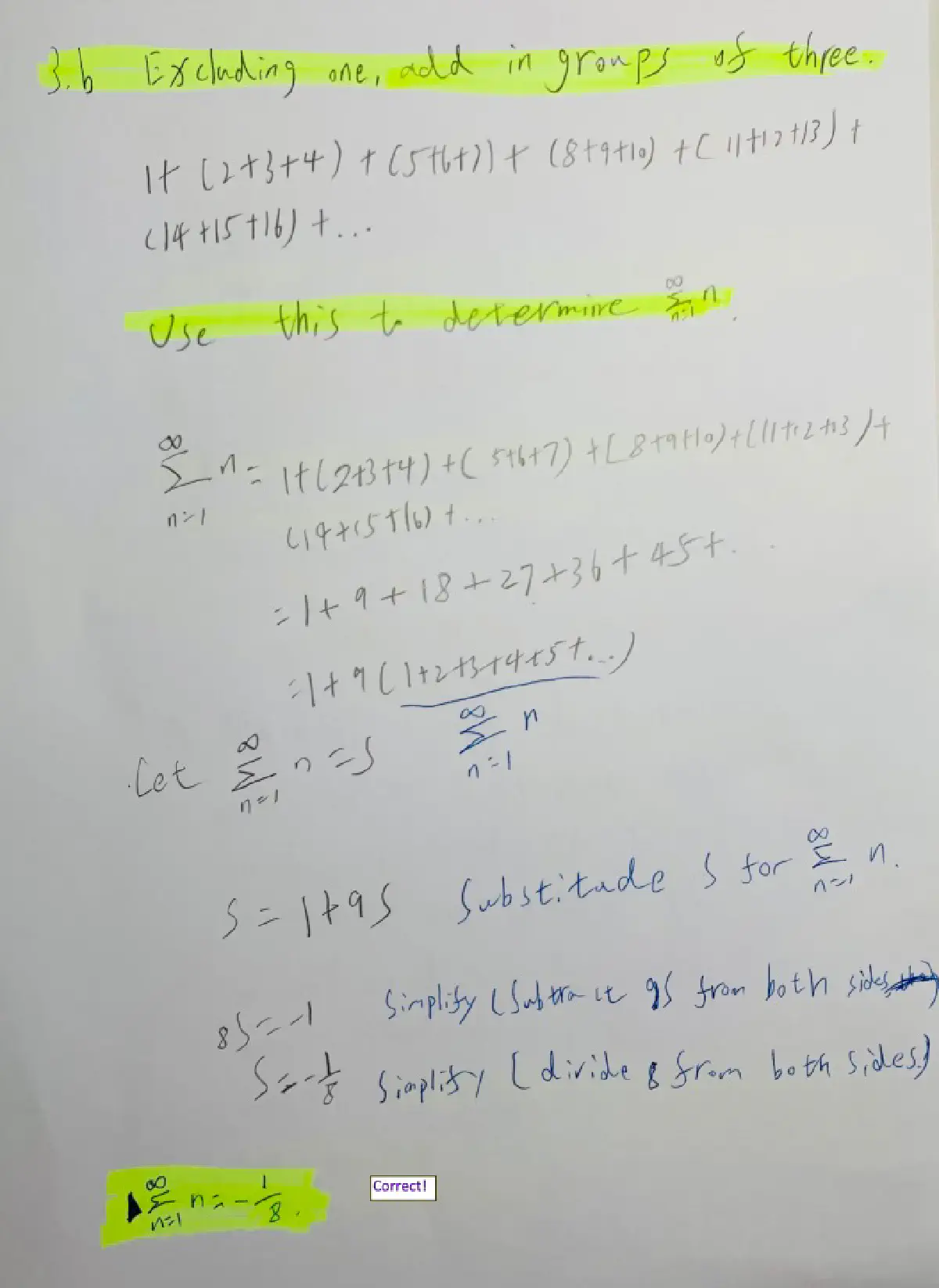
b. Now we will take a different approach. Excluding 1, add the sum in groups of threes until you have enough to see a pattern. $$1+(2+3+4)+(5+6+7)+\dots$$ Use this pattern to find $\sum\limits_{n=1}^{\infty}n$
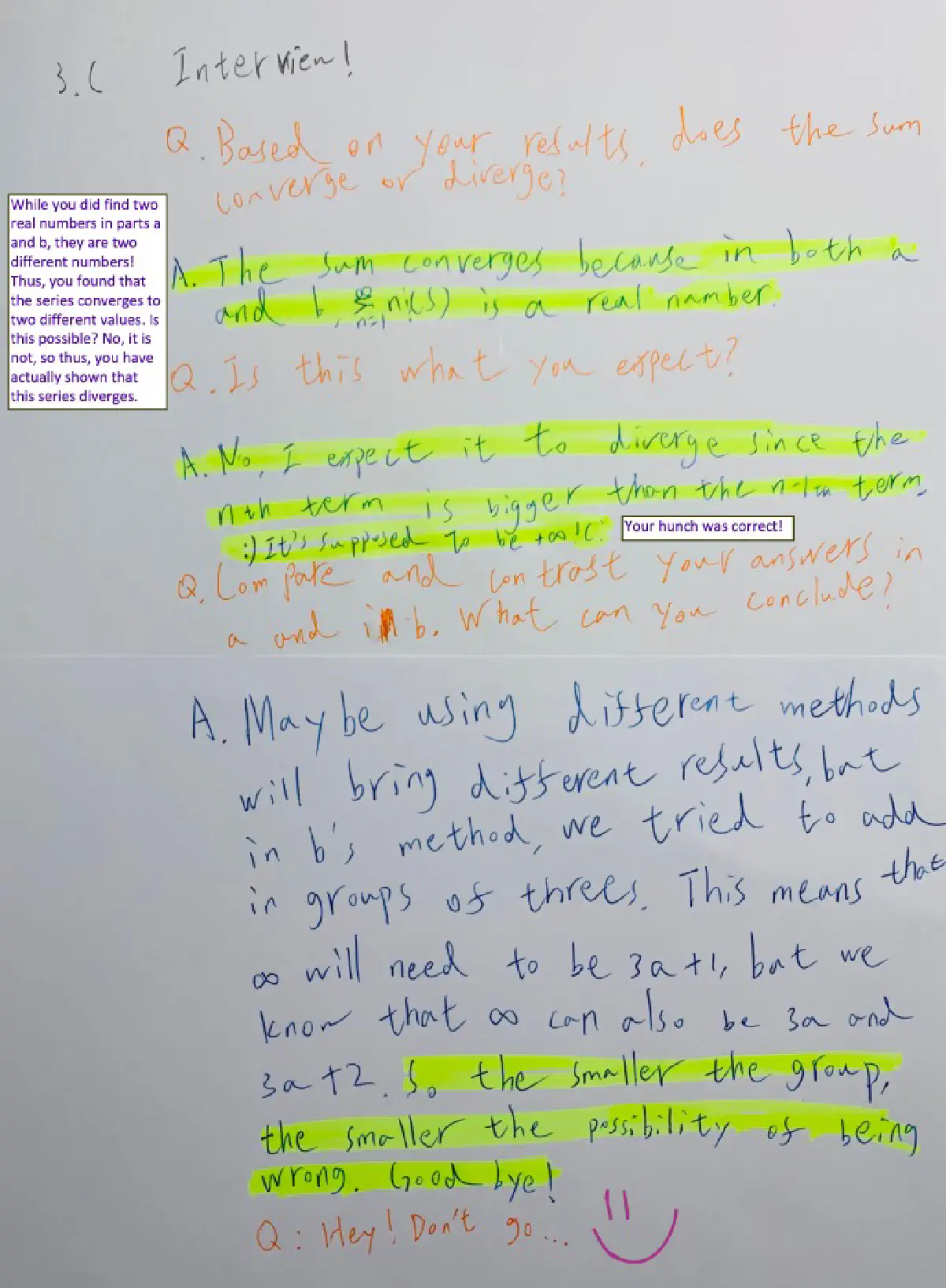
c. Based on your results, does the sum converge or diciverge? Is this what you would expect? Why or why not? Compare and contrast your findings in parts $a$ and $b$. What can we conclude?