Complete each problem below by hand. Show your work and provide a reason for each step. Calculators are not allowed on this assignment.
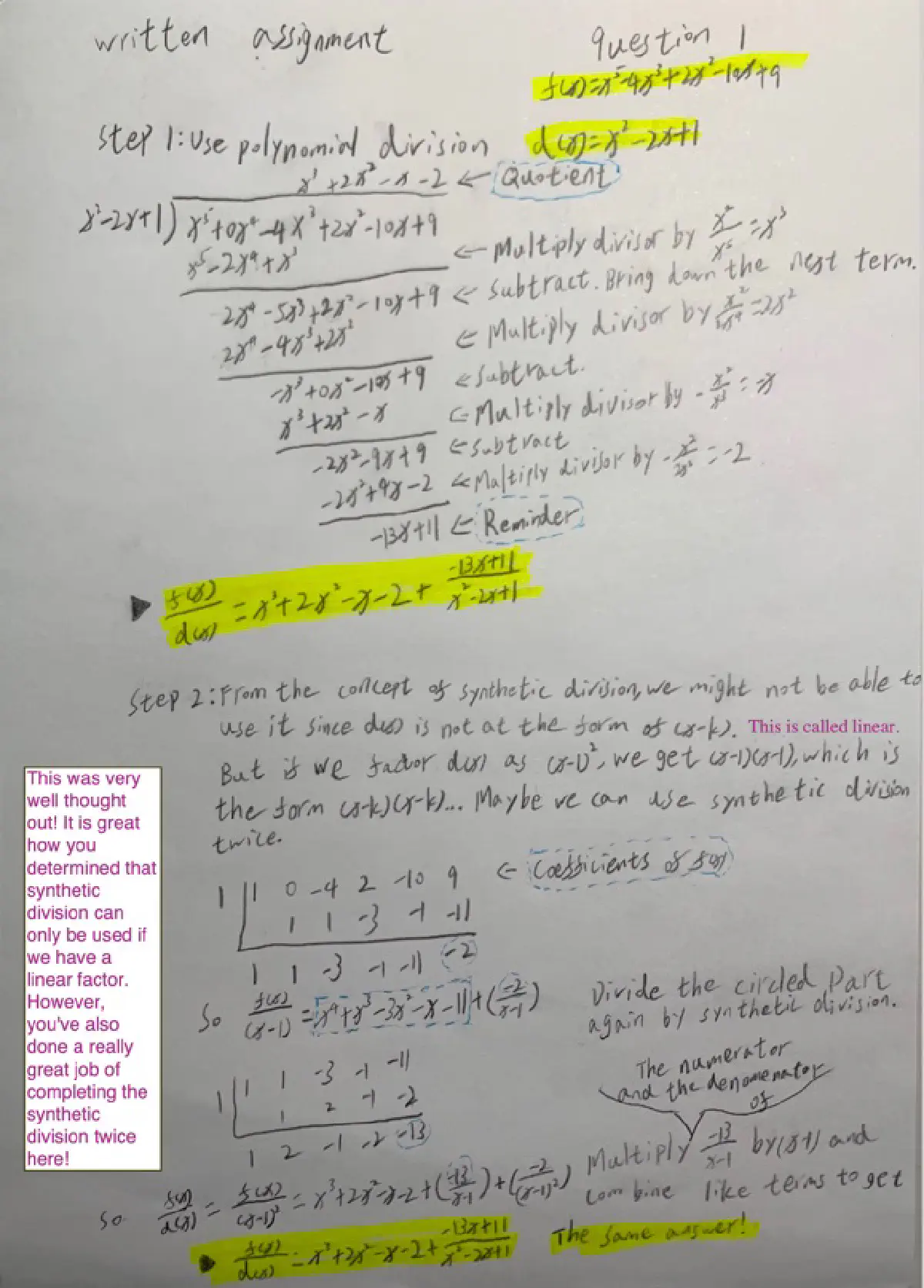
- Let $f(x)=x5−4x3+2x2−10x+9$ and $d(x)=x2−2x+1$. Determine $\frac{f(x)}{d(x)}$ using polynomial division and write your solution as a function. Clearly show your work. Can synthetic division be used here? Why or why not?
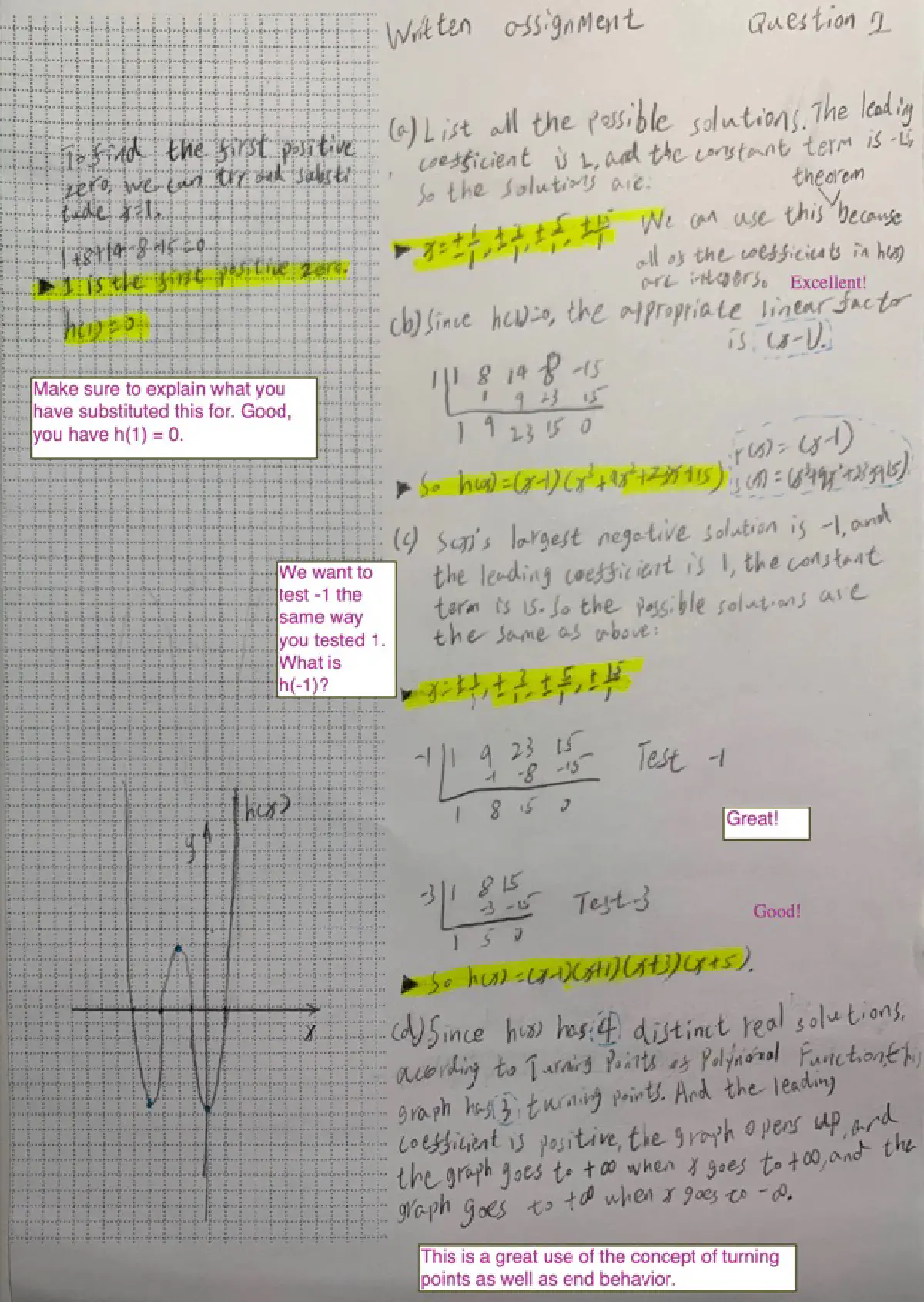
- Let $h(x)=x^4+8x^3+14x^2−8x−15$.
a. Use the Rational Roots theorem to find the first positive zero of $h(x)$. Make sure to show all possible rational roots and provide why you can utilize this theorem for $h(x)$.
b. Use your finding from part (a) to identify the appropriate linear factor. Then use synthetic division to rewrite $h(x)$ as the product of a linear factor and a cubic factor so that $h(x)=r(x)s(x)$.
c. Use the Rational Roots theorem to find the largest negative zero of the cubic $s(x)$. Make sure to show all possible rational roots. Use this zero along with synthetic division to completely factor $h(x)$.
d. Draw a rough sketch of the function (this should be general without plotting points). Explain how determined this sketch and the calue of using the process of parts $a-c$ in finding the roots and graphing a polynomial function.
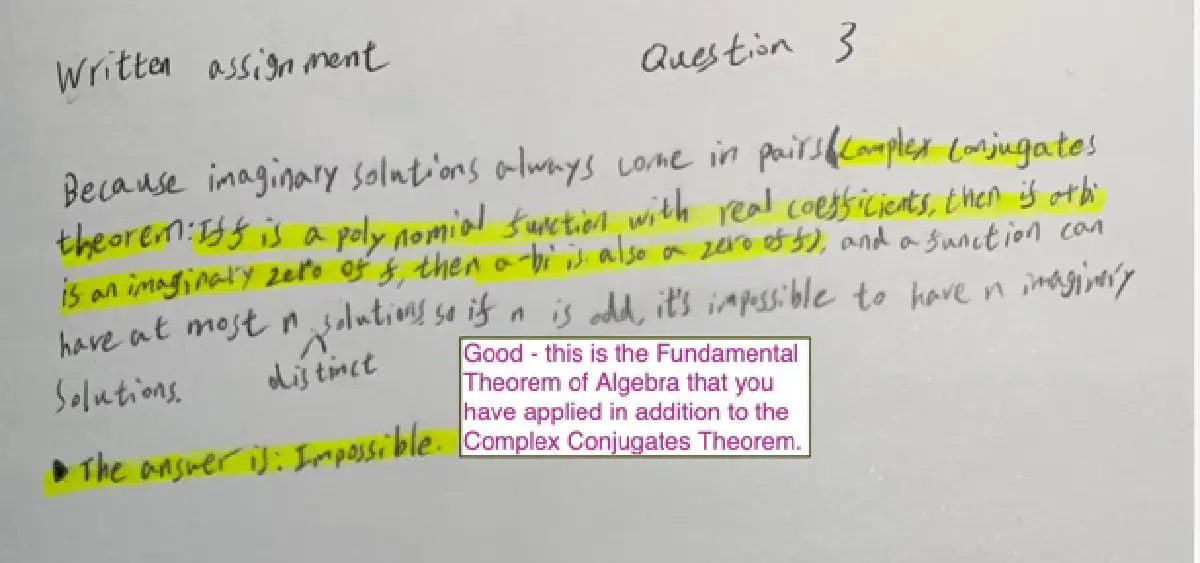
- If a polynomial equation has an odd degree $n$, is it possible for it to have $n$ imaginary solution? Explain…